

The working day has a curious way of using up energy far faster than we expect. There is the morning lift from coffee, then lunch, and then that unannounced but familiar moment around three in the afternoon when your mind starts wandering and your hand automatically reaches for the drawer. Never mind that it contains only uninspiring wafers and dry biscuits — at least they are snacks for work.
But the question keeps coming back: what can you do to stop that moment happening at all? The answer lies not in coffee, but in what you eat between main meals. The right snack is not a sweet reward for a long meeting, but a way to maintain steady productivity from morning until the end of the working day.
Why does what you snack on between meetings matter?
To understand why one snack works and another does not, it helps to look a little more closely at how the body manages energy. When we eat something that quickly breaks down into sugar — sweets, a white-bread sandwich or fruit juice — blood glucose rises sharply. The brain and body receive a boost, and we feel energised. But that rise soon ends in an equally sudden slump, experienced as drowsiness, difficulty concentrating or the irritating feeling of being hungry again despite having eaten only an hour earlier.
Dietitian Sandrija Čepkauskienė, who holds a doctorate in biomedical sciences, has noted that an optimally balanced snack should combine healthy fats, protein, fibre and carbohydrates. This allows glucose to be absorbed more evenly and keeps energy levels stable for longer. In other words, it is not how much we eat, but what is in the food that determines whether we can concentrate after lunch.
What should a good office snack actually contain?
Before moving on to specific suggestions, it is worth defining what we are looking for. The office setting adds a few requirements: food should be easy to take with you, should not bother colleagues with its smell, should be tidy to eat and, of course, should provide real fullness rather than a fleeting moment of pleasure.
Healthy fats and protein are the foundation of fullness — they slow digestion and signal to the body that all is well. Fibre complements this process: it not only supports digestion but also slows sugar absorption further. Natural sweeteners from fruit or berries have a gentler effect than refined sugar, so a sweet snack does not necessarily mean an energy spike and slump. Then, of course, there is the format: an ideal office companion fits in your bag, needs no plate and leaves no marks on your desk.
The most popular healthy office snacks — and what they lack
Many people trying to eat more healthily at work turn to a few classic options. They are certainly better than crisps, but each has its limitations.
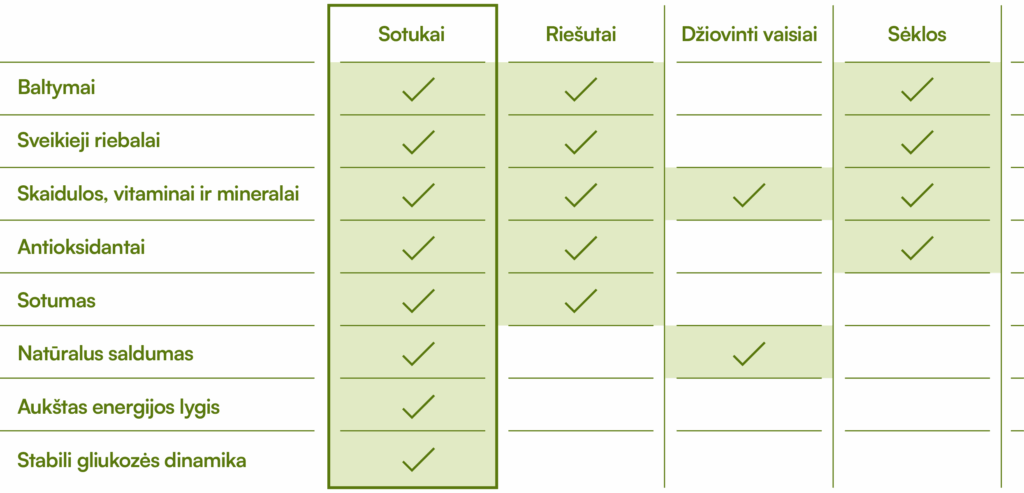
Nuts and seeds — an excellent source of fats and protein. A handful of almonds or walnuts certainly helps you feel fuller. The problem is that nuts alone do not provide the vitamins, antioxidants or fibre needed for all-round wellbeing. They are food from a single nutritional group, rather than a comprehensive solution.
Fresh berries and fruit — a light, refreshing source of vitamins and fibre. Unfortunately, they are absorbed fairly quickly and do not keep you full for long, particularly without added protein or fat. They also need regular replenishing, chilled storage and prompt consumption.
Greek yoghurt — a valuable source of protein and probiotics, suitable for those with an office fridge. However, it is a dairy product, unsuitable for people with lactose intolerance or vegans, and carrying it to work every day is not the most convenient option.
Vegetable sticks with houmous — fresh, filling and nutritious. Paired with a combination of chickpeas, sesame and olive oil, they bring together protein, fibre and healthy fats. Excellent if you have time to prepare and carry them, but certainly not an option for spontaneously opening your desk drawer.
All these options have a clear advantage over processed snack foods, but each involves a compromise: convenience, nutritional value or versatility. Health-conscious people with busy lives generally do not want to choose — they need all of these in one product.
Sotukai: all the ingredients you want in one mouthful
This is precisely where it is worth mentioning Sotukai — Lithuanian handmade plant-based snack balls created in response to the same dilemma: how to eat nutritiously every day without the time or desire to complicate your routine. Each is literally a concentration of superfoods. They contain what the day requires: almonds and cashews provide healthy fats and protein; hemp seeds and chia seeds add fibre and omega fatty acids; goji berries, sea buckthorn and blackcurrants provide antioxidants and vitamins; while Medjool dates, apricots and quince provide natural sweetness without any refined sugar.
The result is a small ball bringing together more than two dozen superfood ingredients. Ten Sotukai, approximately 100 grams, provide 12.5 g of protein and half the recommended daily fibre intake. For comparison, you would get that much fibre from a large bowl of oats or several pieces of fruit in succession.
Because they contain no dairy products, gluten or added sugar, Sotukai are suitable for practically everyone: vegans, people intolerant to lactose or gluten, those who exercise, people working long hours, and anyone who simply does not want a healthy choice to take up time or demand compromises.
Flavours that keep things interesting
One advantage of Sotukai in an everyday routine is that they do not quickly become boring. The range is broad: classic options with cocoa and lemon, more refined ones with matcha and maca, warmer notes of ginger and turmeric, and slightly surprising combinations with maca or chilli. A nine-flavour selection in your desk drawer means every day can be a little different — a small detail that can improve the usual office routine.
Storage and serving: no complications
Storage is one of the things that makes Sotukai so convenient for people on the go. If you plan to eat them within two weeks, there is no need for a fridge: they keep well in a drawer, bag or car boot. The only condition is to protect them from moisture. For longer storage, a fridge or even a freezer is suitable, allowing you to take them out as needed.
The recommended portion is 4–5 Sotukai once or twice a day, with a glass of water or tea. Because of the high fibre content, fluids really matter — they help make the feeling of fullness complete and long-lasting. This is not a snack to eat handful after handful, but a quiet, steady companion between main meals.
Conclusion: the best office snack is one you do not have to choose afresh each time
Healthy snacking at work is not about willpower or conscious discipline every day. It is about what you have to hand when hunger strikes at the wrong time. Nuts, berries, yoghurt and vegetables are all good choices in the right context. But if you want one option without compromises between convenience, nutritional value and taste, Sotukai certainly pass that test.
Lithuanian origins, handmade production, real ingredients and flavours that stay interesting: this is not marketing copy, but a simple description of what is in the box. Once you know what is inside, that hand reaching out at three in the afternoon can finally turn away from the packet of wafers.
Find out more about Sotukai, their ingredients and flavours at sotukai.lt.