

Diet when living with diabetes is highly individual: what works for one person may affect someone else very differently. The information in this article is therefore general in nature. It can help you understand which snacks may be more suitable and what to look out for, but it cannot replace advice from your own doctor or dietitian.
Clearly, diabetes and healthy snacks is a topic that raises many questions. People living with diabetes often feel hungry between meals, and a poorly chosen snack can cause a sharp rise in blood sugar. But that does not mean your only options have to be boring or offer little value. You simply need to know what to look out for, which is not as complicated as it sometimes seems.
What causes blood sugar fluctuations after a snack?
The main factor is how quickly carbohydrates from food enter the bloodstream. The faster they enter, the greater the blood sugar spike. Several things determine this speed: the fibre content of the food, the presence of fats and protein, how processed the product is and the portion size. Highly processed products — white crackers, sweets and fruit juice — act quickly and intensely. Less processed foods containing fibre and protein act more slowly and steadily.
The glycaemic index (GI) is a measure of how quickly a particular food raises blood sugar. Foods with a low GI (up to 55) raise it slowly, which is generally more favourable for people living with diabetes. But GI is not the only consideration: portion size and the combination of foods also matter a great deal. Nuts eaten with dried fruit have a lower overall effect on sugar absorption than dried fruit alone, because the fats and protein in nuts slow sugar absorption.
Healthy snacks: what should you look for?
The best healthy snacks for people living with diabetes have three things in common: they contain fibre, protein and healthy fats. This combination slows the entry of sugar into the bloodstream and keeps you feeling full for longer, reducing the urge to eat more frequently and impulsively.
Nuts are one of the best examples of this combination. Almonds and cashews are low in carbohydrates and high in healthy fats and protein, which means a low glycaemic response. Studies show that nuts help stabilise blood sugar after meals and are considered a suitable part of the diet for people living with diabetes.
Dried fruit is a more complex matter. Removing its water increases the concentration of sugar, so portion size needs careful thought. However, dried fruit retains fibre, which slows sugar absorption. The combination is what matters: a small amount of dried fruit with nuts has a different effect from the same fruit eaten on its own. Studies confirm that this combination can be a suitable snack for people who need to monitor their blood sugar, provided attention is paid to quantity.
What should you look for on the label?
Many products are marketed as ‘sugar-free’ or ‘suitable for diabetes’, but labels can be misleading. First, look at the total carbohydrate content, rather than just the ‘added sugar’ line. Many products contain refined carbohydrates that act similarly to sugar in the bloodstream, even though they are not called sugar. Second, check the fibre content: the more fibre, the more slowly carbohydrates are absorbed. Third, look at the ingredients list: the shorter it is and the more recognisable its components, the less processed the product.
Sweeteners also need attention. Stevia and erythritol have practically no effect on blood sugar. However, maltitol and sorbitol, often used in ‘sugar-free’ products, do have an effect and may cause digestive discomfort. A ‘no added sugar’ label therefore does not mean that a product is suitable without qualification.
Practical choices
Some options generally considered suitable, always taking your own circumstances into account, include mixed nuts without salt or sugar: a small handful keeps you feeling full for hours without raising blood sugar. Berries : a low GI, plenty of antioxidants and relatively little sugar. Vegetable sticks with houmous : protein and fibre together. A hard-boiled egg : no carbohydrates and plenty of protein.
The principle is simple: diabetes and healthy snacks are compatible when you choose real food: minimally processed, with a short ingredients list and plenty of fibre and protein.
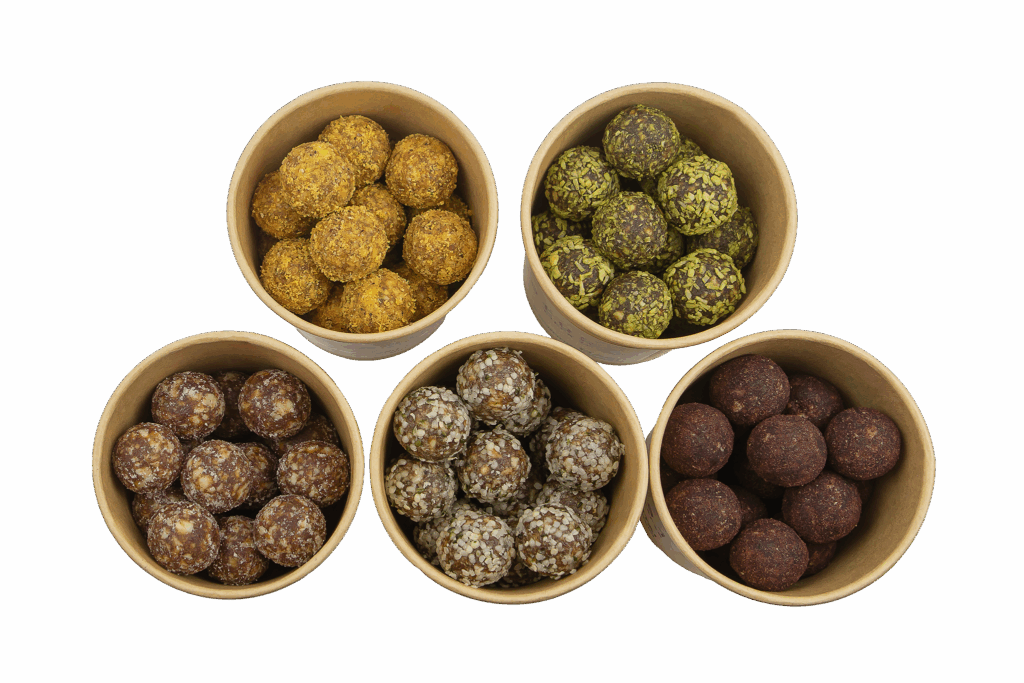
Sotukai: an honest look at what is suitable and what is not
Sotukai are healthy, plant-based snacks with no added sugar and no gluten, handmade in Kelmė. They contain nuts, dried fruit and sometimes spices. Their sweetness comes from dates or apricots, rather than refined sugar. The fibre and nut fats present alongside them slow sugar absorption , so they are not the same as an ordinary sweet.
However, one thing must be made clear: Sotukai are not specially designed for people living with diabetes and have not been medically approved as such. They do contain naturally occurring sugars, so portion size needs careful thought. The Sotukai ‘Sea buckthorn and quince with apricots’ variety, in which more tart fruit predominates, is a slightly less sweet option. As with any new product, it makes sense to start with one or two balls and observe how your body responds. It is certainly worth trying, though.
Diabetes and healthy snacks are not incompatible. They call for more care and awareness than everyday snacking, but also offer an opportunity to choose products that genuinely nourish rather than merely quieten immediate hunger.