
Healthy snacks are about more than counting calories: they are also a sensible strategy for avoiding that unpleasant feeling when hunger strikes too early before lunch or dinner. If you intend to lose weight, or simply do not want to gain it, what matters is not only what you eat at your main meals, but also what you snack on between them. One of the most common recommendations from nutrition specialists is to choose snacks that keep you feeling full for longer, rather than those that give you a quick energy boost and leave you hungry again twenty minutes later.
Why healthy snacks matter when losing weight
Feeling full depends not only on how much you eat, but also on which nutrients your food contains. Scientific studies consistently show that protein and fibre are the two most important factors in making a snack genuinely helpful for appetite control. One published clinical study found that a combination of protein and fibre keeps you feeling full for longer than either component alone, even when the total amount of protein is not particularly high. Research into the relationship between snacks and satiety also confirms that nuts and other unsweetened, natural snacks prolong the feeling of fullness and help people eat less at their next meal.
Protein suppresses ghrelin, the hormone responsible for hunger, while fibre slows digestion and glucose absorption. Studies show that sufficient protein not only reduces appetite but also helps preserve muscle mass and maintain metabolic rate during weight loss , which is especially relevant if you want to change your actual body composition as well as the number on the scales.
Healthy nut-based snacks: are they suitable for weight loss?
One of the most common myths is that nuts contain too much fat and should therefore be avoided. Scientific evidence tells a different story. Epidemiological studies and clinical trials show that regular nut consumption is not associated with weight gain. The reason is simple: the protein, unsaturated fats and fibre in nuts create a strong sense of fullness that naturally leads people to eat less at subsequent meals.
Almonds have been studied particularly extensively. A comprehensive review of 64 clinical studies found that almonds were the only nut whose consumption was associated with a statistically significant reduction in body weight. Almonds activate satiety signals, increase energy expenditure at rest and, most importantly, some of their calories are simply not absorbed because of the structure of the nut’s cell walls. In other words, the calories in almonds on paper and the calories actually absorbed are not the same figure. The key is a sensible portion: a handful (around 20–30 grams) makes an excellent snack, but eating large quantities before every meal does not make sense.
Fibre and protein work better together
The role of fibre in weight loss is often underestimated. Soluble fibre forms a gel in the stomach that slows glucose absorption, so energy remains stable after fibre-rich snacks, without peaks and crashes. A study available on PMC found that a snack with a moderate amount of protein and a good dose of fibre suppresses hunger similarly to food with much more protein but little fibre. A practical tip: look for snacks containing both components: this is more effective than choosing products that provide only one.
Shop shelves are full of products labelled ‘light’ or ‘fat-free’. The problem is that, when fat is removed, the flavour is usually made up for with sugar, causing glucose to rise and fall rapidly. These products often only look healthy while actually contributing to an excessive calorie intake. It is worth reading the ingredients list: sugar or syrup should not be among the first ingredients, and there should be at least 3–5 g of fibre per serving.
When natural ingredients speak for themselves: Sotukai balls
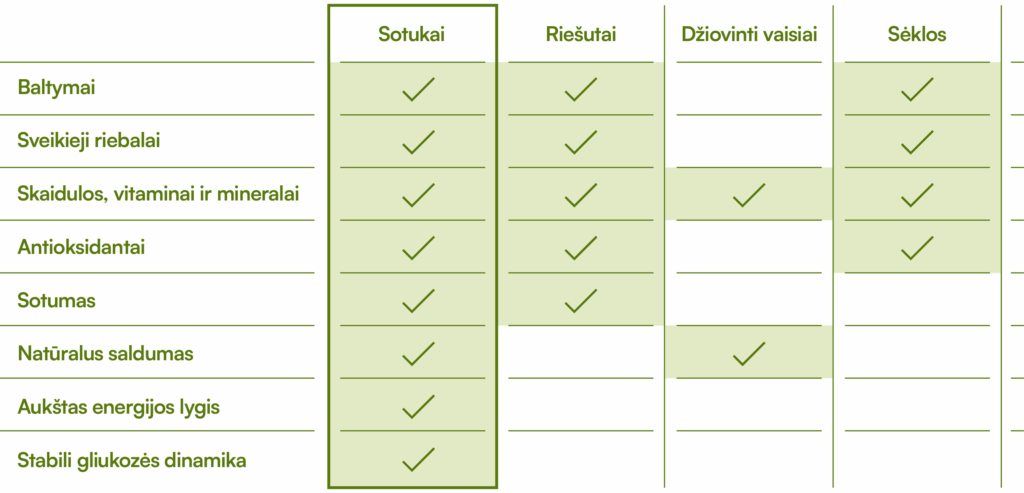
When discussing healthy snacks for weight management, a Lithuanian alternative that meets all the satiety criteria just described is worth mentioning. Sotukai, plant-based, bite-sized balls from Kelmė, combine almonds, cashews, Medjool dates, hemp seeds, goji berries, lingonberries, blackcurrants, matcha, baobab and other superfood ingredients. 10 Sotukai (100 g) contain 12.5 g of plant protein — a substantial amount even by the standards of clinical studies. This is real food, rather than a sports supplement: a snack with no added sugar and no gluten.
The range lets you choose according to your needs. Lingonberry and maca balls in almonds suit those looking for a combination that boosts energy and keeps them feeling full for longer. Hemp seeds with dates are an option with a higher plant protein content. Goji with apricots are a milder, antioxidant-rich choice. Raspberries and baobab with dates are a balanced combination enriched with baobab fibre. The recommendation is to eat 4–5 balls when hungry, with a glass of water.
Start with a plan, and the results follow
Healthy snacks work as part of a system for weight loss, rather than as a miracle solution. When a snack supplies protein, fibre and healthy fats, satiety signals reach the brain sooner and last longer. At your next meal, you no longer want to eat as much as you would if you were very hungry. Scientific studies confirm that the energy from nuts and similar products is naturally compensated for : the body adjusts other meals itself. Try planning your snacks as thoughtfully as your main meals for one week. After seven days, you are likely to notice that hunger between meals is less persistent.