
Natural sweeteners are one of the most frequently mentioned terms in today’s food industry. However, the word ‘natural’ on a pack does not guarantee that a product is automatically healthy or that its sweetness affects the body differently from refined sugar. The real difference lies not only in the source of the flavour, but also in what comes with the sweetness: fibre, polyphenols and minerals, or simply energy with no other nutritional value.
Natural sweeteners and the glucose response
The main difference between natural and refined sweeteners is how they affect blood glucose. Refined sugar is absorbed quickly because it contains no fibre to slow the process. Natural sweeteners from fruit, berries or fruit powders usually enter the body with fibre. Fibre slows sugar absorption and reduces the post-meal glucose spike. Scientific research supports this: a 2022 review of soluble fibre found that fibre reduces the glucose response by slowing digestion and stimulating the release of hormones that encourage a feeling of fullness.
Dates are one of the most extensively studied natural sweeteners. Studies suggest that dates are a promising alternative to refined sugar in the food industry because of their fibre, polyphenol and mineral content. Their glycaemic index ranges from 42 to 55 depending on the variety — a low to moderate figure compared with refined sugar’s index of 65–70. In other words, the same sweetness from dates and from white sugar affects blood sugar differently.
Natural sweeteners from berries: polyphenols
Berries — lingonberries, blackcurrants, goji berries, raspberries and sea buckthorn — provide more than sweetness. Their colour indicates anthocyanins and other polyphenols that act as antioxidants. A 2022 scientific review comparing the phytochemical properties of eight berry species found that blackcurrants and raspberries had the highest total polyphenol content and antioxidant activity. Another study also found that berry polyphenols can inhibit an enzyme that breaks starch down into glucose, which further reduces the glucose response when berries are eaten with carbohydrates.
Goji berries stand out in this respect for their combination of polyphenols and polysaccharides. Their sweetness is mild, and their antioxidant properties are well documented. Sea buckthorn is another example: its tart flavour comes with vitamin C, flavonoids and organic acids that provide additional nutritional value.
It is important to remember that sweetness obtained from natural berries and fruit acts very differently in the body from sweetness obtained from refined sugar.
Are all sweeteners in sweet treats equal?
It is important to understand that natural sweeteners are not all the same. Although agave syrup comes from a plant, it is high in fructose. A high concentration of fructose without accompanying fibre or polyphenols can cause problems of its own, especially for the liver. Honey is natural and has antioxidant properties, but its glycaemic index is not low. Natural fruit sweeteners — dates, apricots and lingonberries — are quite different, retaining all their natural nutrients. This is a fundamental distinction: it is not ‘extracted’ sweetness, but fruit with all its valuable nutrients.
Natural sweeteners in Sotukai: good ingredients in practice
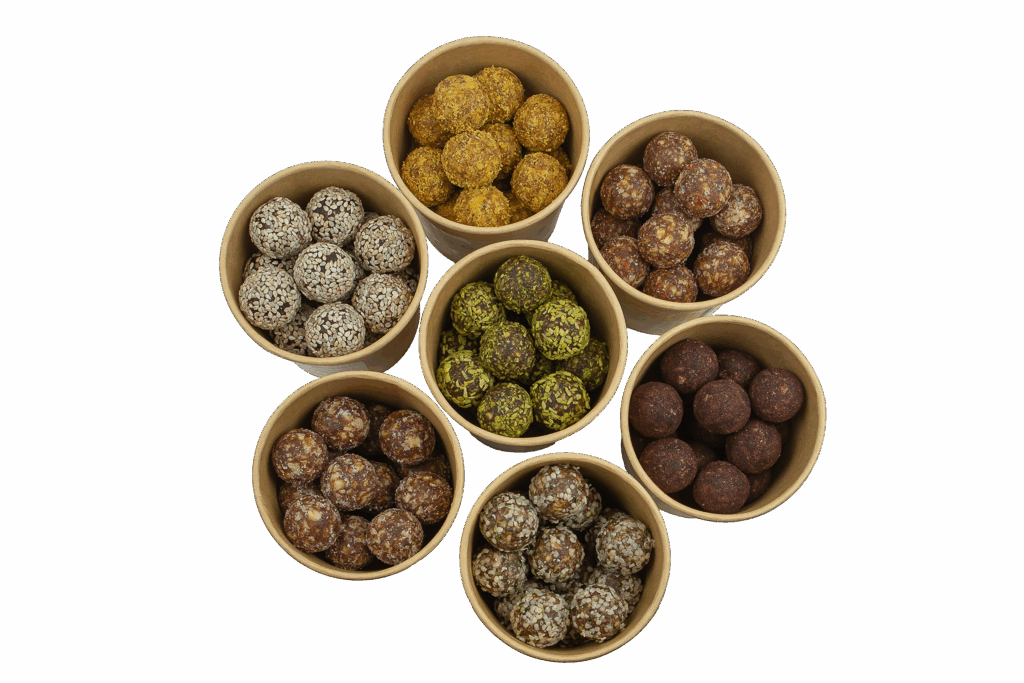
Sotukai plant-based balls are one of the clearest examples of how natural sweeteners can form the whole basis of a product, doing more than replacing sugar to create a different nutritional profile. Each variety of balls is based on a specific combination of fruit or berries that has a dual role: providing sweetness and adding nutritional value.
Raspberries and baobab with dates : in this variety, Medjool dates provide sweetness, raspberry powder adds tartness, and baobab contributes fibre and vitamin C. Blackcurrants with apricots and dates : blackcurrants provide a high concentration of anthocyanins and polyphenols, apricots provide natural sweetness with beta-carotene, and dates provide a matrix of fibre and minerals.
Goji with apricots : goji berry polysaccharides and soft, sweet apricots make the gentlest, mildest combination. Lingonberry and maca balls in almonds : lingonberries bring anthocyanins and vitamin C, maca powder brings adaptogenic properties, and almonds provide a matrix of protein and unsaturated fats. Spirulina with apricots : strong phytochemical potential against a background of natural apricot sweetness. Matcha and cashews with dates : matcha provides antioxidants, while dates provide fibre and minerals.
None of these varieties contains added sugar. In every case, the sweetness comes from the fruit or berry itself, exactly as the principle of natural sweeteners should work.
Reading the ingredients list: the only reliable filter
Natural sweeteners are a better alternative to refined sugar when presented in their complete plant-based context , with fibre, polyphenols and micronutrients. Extracted date syrup or agave nectar no longer has this context. The best filter when shopping is therefore not the word ‘natural’ on the front of the pack, but the ingredients list. If the first ingredients are recognisable fruit, berries or nuts, the product meets what the concept of natural sweeteners should really mean.